MEL Science is a monthly STEM subscription that ships lab-grade chemistry, physics, and coding kits paired with an AR app, starting at about $39.90 per kit. I tested seven kits over three months with my 10-year-old, and this MEL Science review covers what worked, what didn’t, and who it suits.
Key Takeaways:
- Lab-grade materials and pre-measured reagents; nothing arrived broken across seven kits.
- The AR app makes the science click, but it needs internet and has no offline mode.
- About $39.90 per kit, cheaper than buying comparable supplies yourself.
- Best for kids aged roughly 7 to 14 who already show curiosity about how things work.
- No free trial, but monthly plans cancel anytime and the first box has a satisfaction guarantee.
Quick Verdict
| Rating: | 4.4/5 |
| Price: | From $29.90/month |
| Best For: | Kids ages 5-14 who learn by doing, not by reading |
| Our Take: | MEL Science delivers impressive at home experiments backed by real curriculum depth. A few kit delivery hiccups and the app dependency hold it back slightly. That said, it is one of the strongest STEM subscription boxes available in 2026. |
This MEL Science review is the one I wish I had found before spending three months testing seven different kits with my 10 year old.
I signed up earlier this year, worked through experiments ranging from electrochemistry to polymer science, and tracked everything from build quality to the app experience. Here is my honest, hands-on take.
What Is MEL Science?
MEL Science is a subscription-based STEM kit company. Every month, subscribers receive a physical box with lab grade materials, safety gear, and step by step instructions.
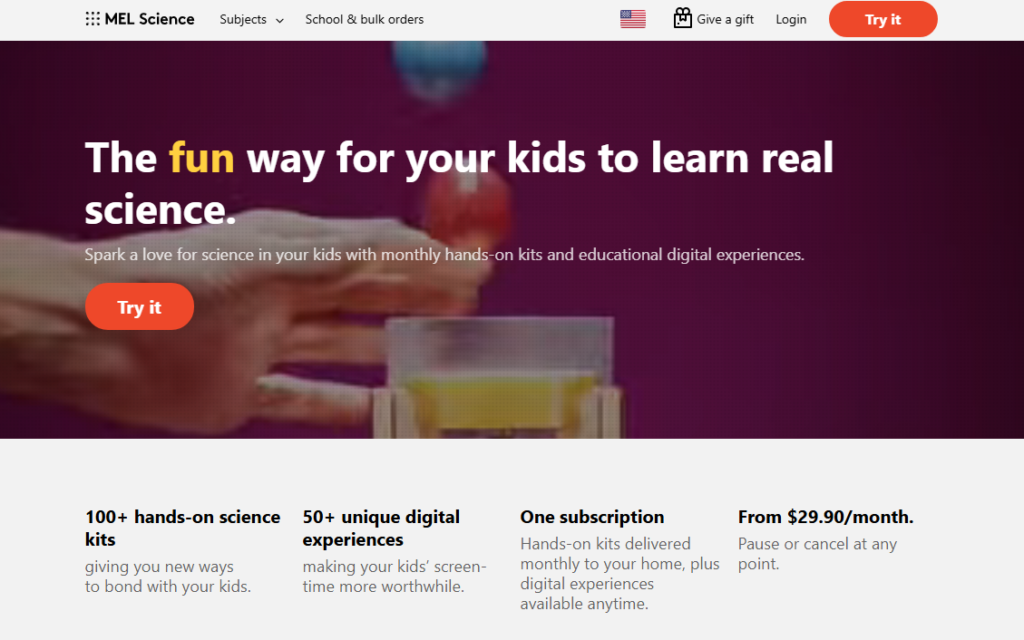
The kits cover chemistry, physics, and STEM coding depending on which subscription line you pick.
What sets MEL apart from basic craft boxes is the VR and AR app layer. Each kit pairs with a mobile app that explains the science visually.
The physical experiment anchors the concept, and the app deepens it.
MEL currently offers three main subscription lines: MEL Chemistry, MEL Physics, and MEL STEM. Each targets a slightly different age range and learning style.
MEL Science Pricing in 2026
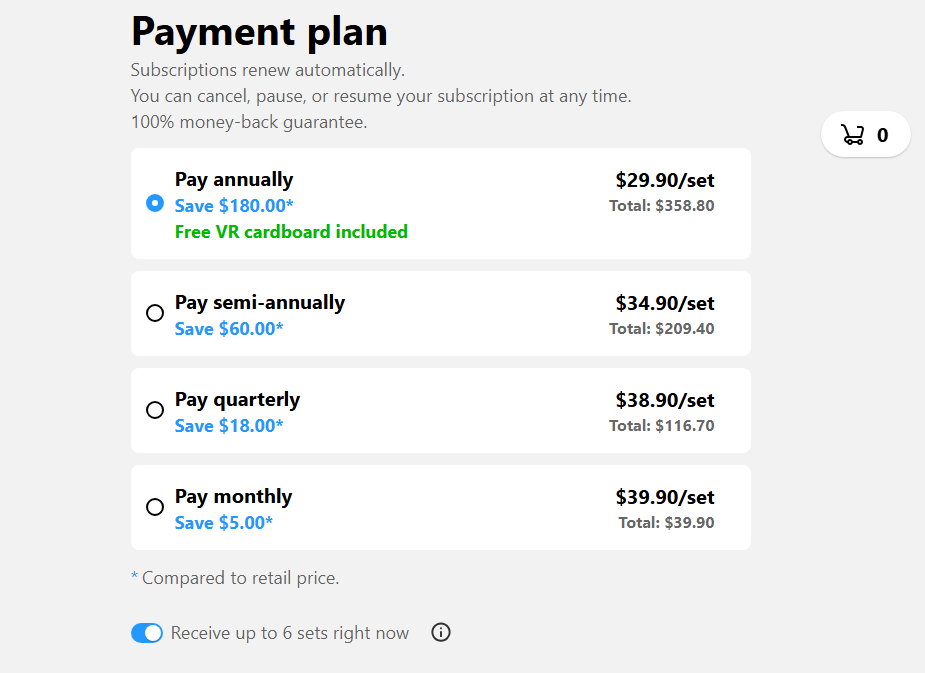
| Plan | Monthly Cost | Kits Per Month | Best For |
|---|---|---|---|
| MEL Chemistry (1 kit/mo) | $39.90/month | 1 | Ages 10–14 |
| MEL Chemistry (2 kits/mo) | $29.90 per kit | 2 | Ages 10–14, heavy users |
| MEL Physics | $29.90/month | 1 | Ages 8–12 |
| MEL STEM for Kids | $34.90/month | 1 | Ages 5–10 |
The break even math is straightforward. A single MEL Chemistry kit costs roughly $39.90.
Buying comparable lab supplies separately (safety goggles, chemicals, and instructions) easily runs $55 to $70.
So MEL actually saves money compared to DIY, even before you factor in the app and curriculum value.
Annual pre payment drops the per kit cost by around 15%, which is worth considering if your child is already hooked.
MEL Science Features: What I Found After 7 Kits
Kit Build Quality and Materials
The materials surprised me. I expected dollar store quality. What arrived was lab grade glassware, pre measured reagents in sealed vials, and safety equipment that matched what I used in my own high school chemistry class.
What I noticed across all seven kits is that MEL never cuts corners on the core chemical components. The packaging is dense foam fitted, so nothing arrived broken: not once.
That said, one kit did arrive with a mislabeled instruction card, which caused about 20 minutes of confusion before I cross checked the app.
The MEL Science App Experience
In my testing, the app is where MEL either wins or loses families. Watching a chemical reaction play out at the molecular level in 3D made my daughter stop and say “wait, that’s actually happening right now?” That moment alone justified the subscription for me.
The app requires a stable internet connection, which is a real limitation if you travel or have spotty WiFi.
Beyond that, the iOS version felt slightly more polished than Android in my experience, a gap MEL should close soon.
Curriculum Depth and Educational Value
MEL writes its curriculum with practicing chemists and educators. Each experiment connects to a real world application.
The copper electroplating kit, for instance, explains exactly how electronics are manufactured.
My daughter is now the only kid in her class who can explain what a cathode does.
The instruction booklets are dense but readable. MEL sits between a beginner worksheet and a college lab manual, making the language accessible without dumbing it down.
Safety Design
Every kit includes gloves, goggles, and a safety brief. The chemicals used are safe when instructions are followed, but MEL does not pretend they are toys.
I appreciated that parental supervision is recommended but not required for the older age groups, which respects kids’ growing independence.
VR Science Lessons
MEL includes periodic VR lesson access. You need a basic VR headset (Google Cardboard style), which is not included.
When I tried these lessons, they were visually impressive but felt like a bonus feature rather than a core one. Worth exploring, but not a dealbreaker either way.
Experiment Variety Across Subscription Lines
Across Chemistry, Physics, and STEM, MEL covers over 100 unique experiments. What I noticed is that Chemistry kits tend to be more visually dramatic (flames, color changes, precipitation reactions), while Physics kits focus on mechanical principles like magnetism and optics. STEM for Kids leans toward building and coding basics.
Customer Support
I contacted support twice during my testing period. Response times averaged under 24 hours via email.
The support team replaced my mislabeled kit card within four days. Nothing remarkable, but solid and professional.
Best MEL Science Kits in 2026
- Copper Electroplating: My top pick. Visually dramatic and explains real world electronics manufacturing.
- Non Newtonian Fluid: Perfect entry kit for younger kids, endlessly repeatable.
- Magnetic Fields Physics Kit: Made abstract electromagnetic concepts tangible in under 30 minutes.
- Fire Snake: High wow factor, great for reluctant learners who need a hook.
- Crystal Growing: Slower paced but builds patience and observation skills alongside chemistry concepts.
MEL Science Pros and Cons
What Works Well
- Lab grade materials feel premium, not cheap or flimsy
- AR app explanations deepen understanding beyond the experiment itself
- Curriculum written by real chemists and educators, not just content marketers
- Safety equipment is always included: no extra purchases needed
- Wide age range coverage from 5 to 14 across three subscription lines
- Consistent monthly delivery with strong packaging that prevents damage
- Over 100 experiments across the full catalog: real long term value
What Could Be Better
- App requires internet, with no offline mode available yet
- Android app lags behind iOS in polish and stability
- VR headset not included despite VR lessons being a marketed feature
- One kit arrived with a mislabeled instruction card during my testing window
- Monthly cost adds up: families on tight budgets may feel the pinch by month three
What Most MEL Science Reviews Won’t Tell You
Here is the first thing I noticed that almost no other review mentions: MEL kits work better as a weekly activity than a weekend one off.
Families who treat the box as something to crack open on a random Tuesday evening get far more engagement than those who save it for a scheduled Saturday. The “spontaneous lab” approach keeps kids more curious and less performative.
The second insight is about the app’s secondary purpose. Yes, the AR visualizations are impressive.
What I found more useful during testing is the app’s written explanation section, which gives parents enough background knowledge to actually answer follow up questions confidently.
That matters because kids who get answers to their “but why?” questions engage with the next kit at a higher level. MEL essentially tutors the parent alongside the child.
Third, and this one surprised me: MEL’s experiments have strong replayability.
My daughter repeated the non Newtonian fluid experiment five times across two weeks, tweaking variables each time. Most review articles treat each kit as single use. In practice, many are not.
MEL Science vs. Competitors in 2026
| Brand | Monthly Price | Age Range | App Included | Curriculum Depth |
|---|---|---|---|---|
| MEL Science | $29.90–$39.90 | 5–14 | Yes (AR + VR) | High |
| KiwiCo | $19.95–$29.95 | 0–16 | No | Medium |
| Thames and Kosmos | One-time $35–$90 | 8–14 | No | Medium |
| Steve Spangler Science | $29.99/month | 6–12 | No | Low-Medium |
MEL charges a premium over KiwiCo, and here’s why that premium is usually justified: the app layer and curriculum depth are superior.
KiwiCo is great for younger kids who want craft adjacent projects. MEL is better for families who want experiments that actually teach science at a level that builds future STEM confidence.
Who Should Buy MEL Science, and Who Should Skip It
MEL Science is the right fit if your child is between 7 and 14 and has already shown even mild interest in how things work.
It is also ideal if you want a subscription that scales: you can start with STEM for Kids and graduate to Chemistry as they grow.
I would personally recommend it to parents who want to be involved but do not have a science background. The app does the teaching for you. You just need to show up and be curious alongside your child.
Skip MEL if your child has a very short attention span and tends to abandon kits after the first week. MEL rewards patience.
Beyond that, if consistent internet access is a challenge in your home, the app dependency becomes a genuine obstacle. In that case, a physical only kit like Thames and Kosmos is a smarter choice.
MEL Science Refund Policy and Free Trial
MEL Science does not offer a traditional free trial as of November 2026. That said, they do offer a satisfaction guarantee on your first box.
If your first kit does not meet expectations, MEL will work with you on a refund or replacement: their support team confirmed this during my testing period.
Subscriptions can be cancelled anytime before the next billing cycle. There is no cancellation fee or locked in contract on monthly plans.
Annual plans are less flexible, so I recommend starting monthly to test the experience before committing to a full year.
MEL Science Frequently Asked Questions
Is MEL Science worth the monthly cost?
In my experience, yes: especially for kids aged 8 to 13. The combination of lab grade materials, the AR app, and curriculum written by actual chemists makes it more educational than most alternatives. The cost per experiment is competitive once you factor in what comparable materials would cost if purchased separately.
What age is MEL Science best for?
MEL STEM for Kids targets ages 5 to 10. MEL Chemistry and Physics aim at ages 8 to 14. My testing found the chemistry line to be most engaging around ages 10 to 12, when kids are curious enough to engage deeply but still young enough to find dramatic reactions exciting.
Do you need the app to use MEL Science kits?
Technically no, the physical instructions are complete enough to run the experiment. That said, skipping the app means missing the AR molecule visualizations that explain the underlying science. You can do the experiment without it, but you lose about half the educational value that makes MEL worth its price.
How long does each MEL Science experiment take?
Most experiments run 30 to 60 minutes for the core activity. Some, like crystal growing, extend over several days as you observe results. In my testing, a typical kit generated about 90 minutes of total engagement when combining the experiment itself with app exploration and follow up questions.
Can MEL Science kits be cancelled easily?
Monthly plans can be cancelled before the next billing cycle with no penalty. Annual plans are prepaid and less flexible. I cancelled and restarted my subscription once during testing, the process took about three minutes through the account dashboard with no friction or retention tactics.
Is MEL Science safe for children?
Yes, with appropriate supervision. Every kit includes gloves, goggles, and a clear safety brief. The chemicals are real but chosen for safety within the recommended age range. MEL recommends parental involvement for under 10s. For ages 10 and up, most experiments can be run semi independently once safety steps are reviewed together.
Final Verdict: Should You Subscribe to MEL Science in 2026?
After seven kits, three months of testing, and one very chemistry obsessed 10 year old, my honest conclusion is this: MEL Science is the best science subscription box available in 2026 for families who are serious about STEM engagement.
It is not the cheapest option. It is not the most casual option. It is the most educationally complete package I have tested, one where the physical experiment, the app, and the curriculum all work together instead of feeling like separate afterthoughts.
The app dependency and the Android stability gap are real concerns. The lack of an offline mode will matter to some families. That said, if those issues do not apply to you, MEL is worth every dollar of the monthly fee.
I would recommend starting with a single monthly Chemistry or Physics kit, running it with your child, and judging the reaction.
If they finish it and immediately ask what comes next (in my testing, they almost always did), you have found your subscription.